


This announcement banner can be used to inform visitors of something important!
An introduction to cellular energy, healthy aging, and the evidence behind the supplement.
Your heart keeps beating while you sleep. Your muscles turn a walk into thousands of coordinated movements. Behind these familiar activities, cells continually produce and use energy.
Coenzyme Q10, usually shortened to CoQ10, participates in that process. Ubiquinol is one of its naturally occurring forms—and a supplement attracting interest for heart health, exercise, fertility, and aging.
Understanding why researchers study ubiquinol starts with mitochondria. Understanding whether a supplement helps requires looking at what happens in people.
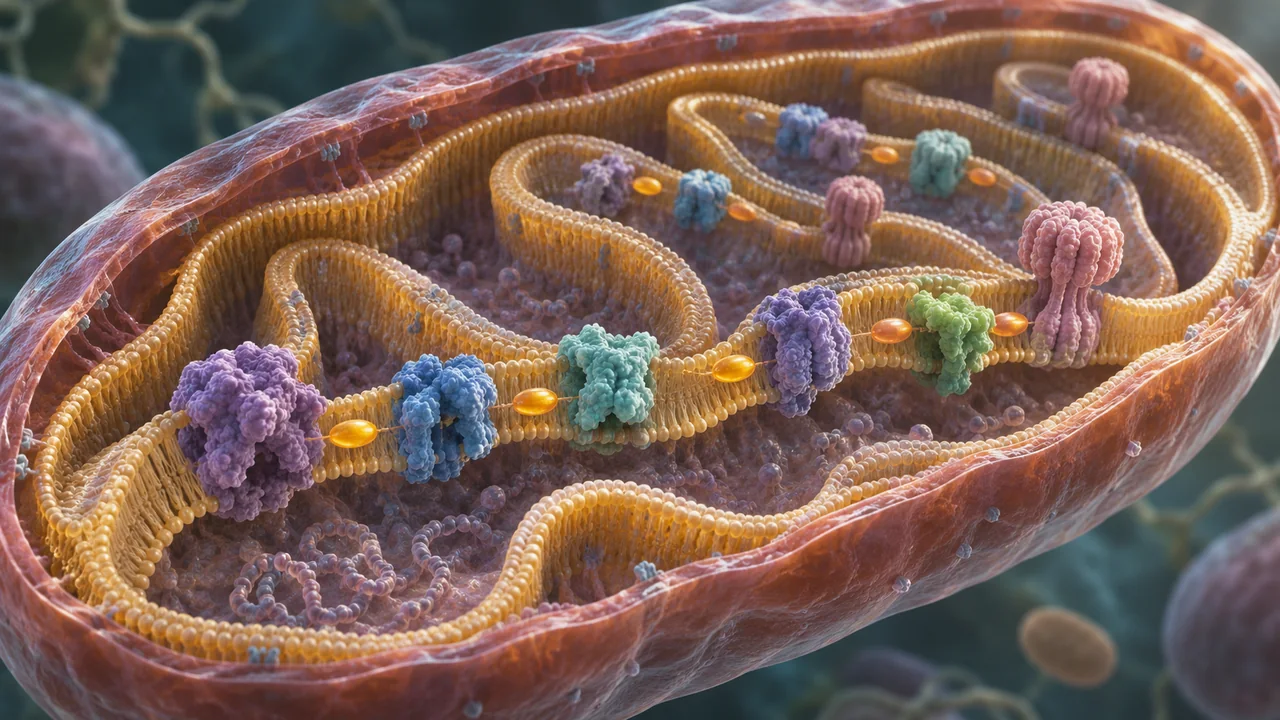
Mitochondria help convert energy from food into ATP, a molecule cells use to power their work. Within the mitochondrial inner membrane, a sequence of reactions transfers electrons and helps create the conditions needed to produce ATP.
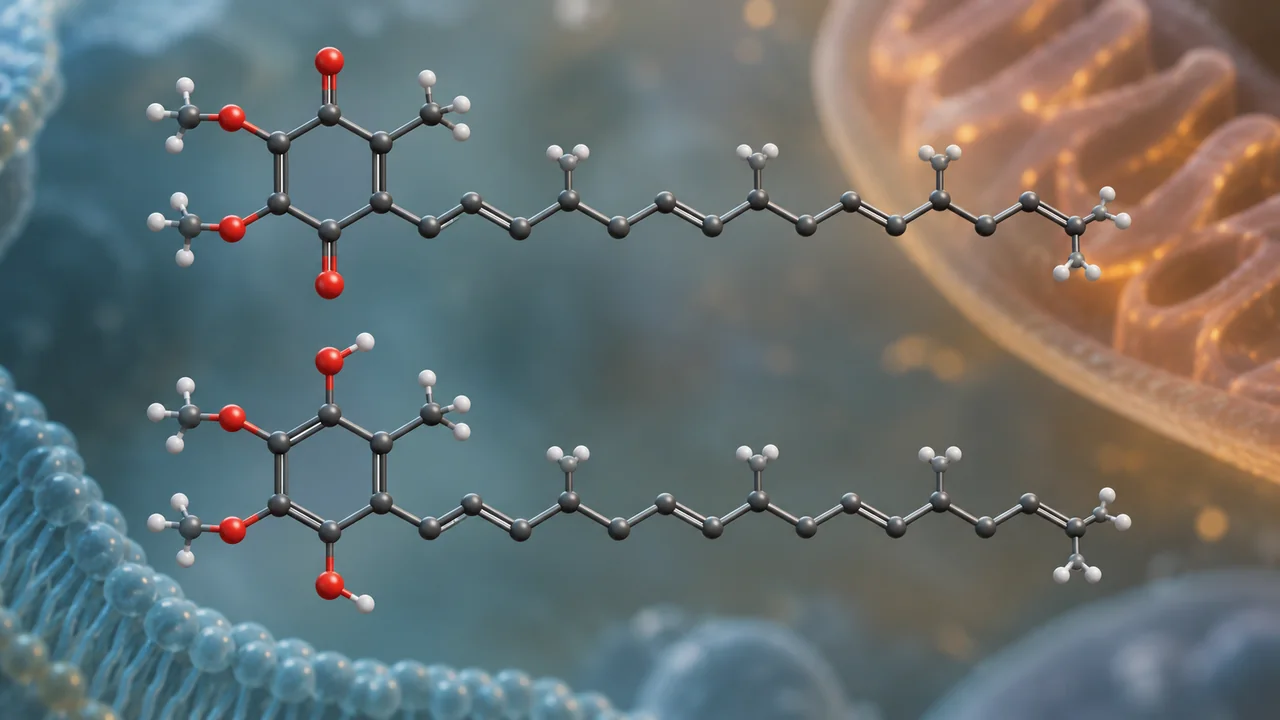
CoQ10 carries electrons between parts of this system. It continually changes between two forms:
Both participate in normal cellular function. Describing ubiquinol as “active” and ubiquinone as “inactive” misses this essential cycling between forms. Ubiquinol also contributes to antioxidant protection in lipid environments, including cell membranes. These roles explain the scientific interest in CoQ10, but they do not by themselves establish that taking extra improves health. Background on the CoQ10 cycle
A useful distinction is between a molecule being necessary and additional supplementation being beneficial. The first can be well established while the second depends on the person, condition, formulation, and outcome being studied.
The answer depends on what “better” means.
A supplement might increase blood concentrations more effectively without producing a greater improvement in symptoms or physical function. Comparisons also involve specific products, whose formulations can differ.
A randomized study published in September 2026 assigned 150 adults to five groups: ubiquinone, ubiquinol, geranylgeraniol, ubiquinol plus geranylgeraniol, or placebo. Over eight weeks, both ubiquinone and ubiquinol increased blood CoQ10 compared with placebo. The difference between those two groups was not statistically significant. The study also found no improvement versus placebo on its health and vitality questionnaires. Read the trial
That result does not prove all products are equivalent. It does show why “better absorbed” and “better for your health” should be evaluated separately.
The paper also disclosed that one author served on a supplement company’s scientific advisory board. Such disclosures do not invalidate findings, but they belong alongside study design, sample size, and results when weighing evidence.

For supplementation to improve mitochondrial function, several things may need to happen: the compound must be absorbed, reach the relevant tissue, enter the appropriate cellular compartment, and address a factor that actually limits function.
A blood test mainly informs the first part of that journey.
In a 2022 randomized trial, 37 people taking simvastatin received CoQ10 or placebo for eight weeks. Researchers examined muscle biopsies as well as symptoms. Supplementation increased circulating CoQ10, but it did not improve muscle CoQ10 content, mitochondrial function, or muscle pain. This was broader CoQ10 research and should not automatically be described as a ubiquinol trial. Read the muscle-biopsy study
The study was small and cannot settle every question about formulations or particular patient groups. Nevertheless, it directly challenges the assumption that a higher blood level necessarily means better cellular energy production.

Animal research provides reasons to investigate ubiquinol further.
In a study of mice bred to develop accelerated aging, researchers found that ubiquinol affected pathways involved in mitochondrial activity and antioxidant defenses. These included SIRT1, SIRT3, and PGC-1α, proteins involved in regulating cellular metabolism. The study reported preservation of several mitochondrial measures and effects on age-related hearing loss. Read the original mouse study
These findings help generate hypotheses. They do not establish that ubiquinol reverses aging, prevents hearing loss, or extends lifespan in humans.
Human research offers a more restrained picture. A 2026 randomized trial studied 111 adults aged 60 and older who received 200 mg of ubiquinol daily or placebo for 90 days. Blood CoQ10 increased substantially, but the ubiquinol group did not perform better on the principal cognitive measures. Measured cardiovascular, inflammatory, and oxidative-stress outcomes also did not improve versus placebo. Read the older-adult trial
Exploratory analyses suggested relationships between changes in blood markers and memory performance within the treatment group. Those observations can inform future studies; they do not replace the main comparison showing no demonstrated cognitive benefit.
The dose is a description of the research, not a recommendation for readers.

Yes. The evidence includes positive results as well as negative ones.
In a 2020 randomized trial, 51 adults with moderately elevated cholesterol and impaired blood-vessel function received ubiquinol or placebo for eight weeks. Among participants who completed the study, both ubiquinol groups showed improved flow-mediated dilation—a measure of how an artery responds to increased blood flow. Read the vascular-function trial
That is a relevant cardiovascular finding. However, the study did not demonstrate fewer heart attacks, longer life, or prevention of cardiovascular disease.
This distinction will recur throughout this series: an improvement in a biological measurement may be valuable, while still leaving questions about how someone feels, functions, or fares over the long term.

Clinicians may weigh biological plausibility, small trials, patient experiences, and uncertainty differently.
For example, Cleveland Clinic cardiologist Leslie Cho explains that evidence is insufficient to establish routine benefit from CoQ10 for statin-related muscle symptoms. Her commentary helps frame a practical question, but the underlying trials remain central. Read the clinician discussion
One particularly relevant randomized trial used ubiquinol specifically. After confirming muscle symptoms through blinded exposure to simvastatin and placebo, researchers assigned 41 affected participants to 600 mg/day of ubiquinol or placebo alongside simvastatin. Ubiquinol did not reduce muscle pain. Read the trial
We will examine the wider statin literature in a later article. For now, the lesson is to evaluate the proposed mechanism and the treatment result as separate questions.

Exercise provides a useful comparison because researchers can measure its effects directly in human muscle.
A 2017 study examined different training approaches in younger and older adults. After 12 weeks, interval and combined exercise training improved skeletal-muscle mitochondrial respiration. This demonstrates that mitochondrial function can respond to activity, including in older age. Read the exercise study
Another distinction concerns MitoQ, a chemically modified compound designed to target mitochondria. It is different from ordinary ubiquinol. Experiments have shown differences in how these compounds interact with the respiratory chain, so results from MitoQ studies cannot simply be assigned to ubiquinol supplements. Read the mechanistic study

When a study reports a benefit, ask:
These questions leave room for promising discoveries while keeping expectations grounded.
Ubiquinol is a scientifically interesting part of cellular energy biology. Its clinical value needs to be established for each proposed use. Anyone considering supplementation should also review medication interactions with a clinician or pharmacist, particularly when taking warfarin or insulin. NIH safety information
Next month, we will look more closely at heart health: what ubiquinol trials have measured, where results are encouraging, and which questions remain unanswered.
Images created with AI for editorial illustration. Molecular views are conceptual; laboratory scenes do not document the cited trials.