


This announcement banner can be used to inform visitors of something important!
Active-Saver™ technology places the Ubiquinol-containing core inside a surrounding gel shell designed to help protect it during storage. Its development centers on a measurable question: how effectively does this two-phase structure limit oxidation over time?
Six-month accelerated stability results provide encouraging evidence. Across bottle and pouch packaging, both Global Products Group’s (GPG) in-house laboratory and Accuscience Labs reported accelerated assay values above the comparison workbook’s 96% specification at every tested time point.
Active-Saver™ uses a center-fill structure to encapsulate the active ingredient within the chewable gel. The surrounding shell is intended to provide a protective barrier, while the stability program evaluates the performance of the finished product and its packaging together.
For Ubiquinol, the study focused on monitoring reduced Ubiquinol and oxidized Ubiquinone. Tracking these forms over time helps assess oxidative changes within the tested product. The protocol also collected information to support improvements in the formulation, manufacturing process, and equipment.
The stability protocol specified accelerated storage at 40°C ± 2°C and 75% ± 5% relative humidity, alongside long-term storage at 25°C ± 2°C and 60% ± 5% relative humidity.
Bottle and pouch configurations allowed the team to evaluate Active-Saver™ chewable gels in two packaging formats. The broader testing plan included appearance, taste, aroma, whole-gummy and core weight variation, water activity, moisture, microbial testing, and elemental contaminants.
The results presented here focus on the accelerated chemical measurements.
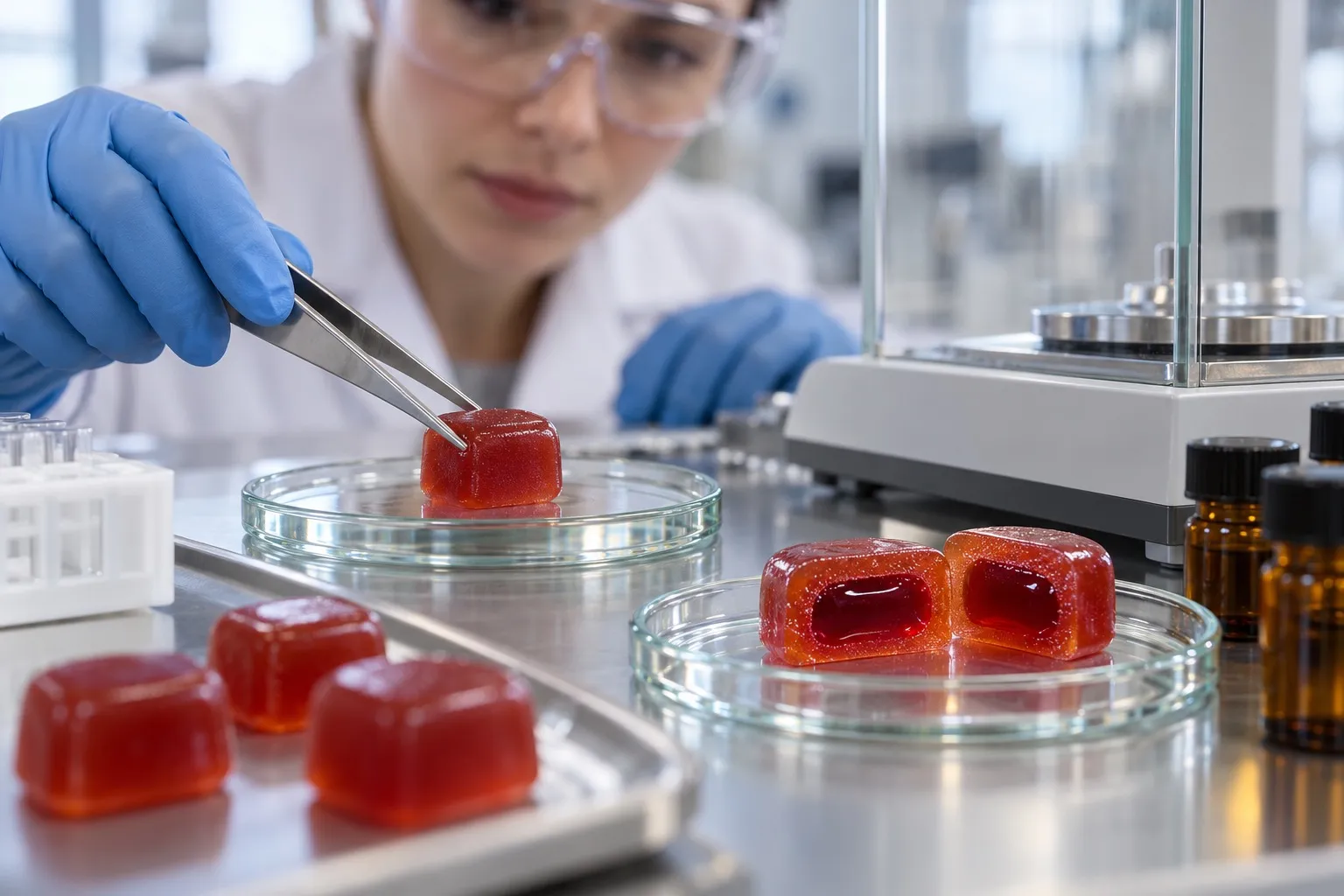
Ubiquinol’s sensitivity to light and oxygen makes sample handling an essential part of the testing process. Exposure during preparation can affect the measured balance between Ubiquinol and Ubiquinone.
The study’s analytical approach emphasized controlled preparation and supporting records, including standards, reagents, sample weights, and chromatography data. Measuring both chemical forms helps distinguish oxidative changes from questions about the quantity of active ingredient delivered in each gummy.
The final comparison compiled measurements at the initial, one-, two-, three-, and six-month time points. The workbook reports the following accelerated values under the heading “Assay”:
| Laboratory / packaging | Initial | 1 month | 2 months | 3 months | 6 months |
|---|---|---|---|---|---|
| GPG in-house — bottle | 97.04% | 97.37% | 97.60% | 97.34% | 96.24% |
| GPG in-house — pouch | 97.04% | 97.30% | 97.89% | 97.56% | 97.18% |
| Accuscience — bottle | 98.33% | 96.92% | 97.82% | 96.60% | 96.68% |
| Accuscience — pouch | 98.16% | 96.37% | 97.78% | 98.22% | 96.54% |
All 20 reported accelerated values met the workbook’s ≥96% specification. At six months, results ranged from 96.24% to 97.18%.
The accompanying oxidation metric, labeled “Ubiquinone / Ubiquinol Ratio %,” ranged from 2.82% to 3.76% at six months. Neither laboratory showed a consistent packaging advantage across the full study. Measurements fluctuated between time points, so the results should not be interpreted as a smooth degradation curve.
The accelerated results support continued development of Active-Saver™ for Ubiquinol chewable gels. Both laboratories reported values above the workbook’s assay threshold throughout six months of testing in both packaging formats.
Understanding the percentages is important. Each accelerated assay percentage in the workbook equals 100 minus its corresponding reported oxidation percentage. These values describe the study’s chemical-form metric; they do not establish the percentage of the original Ubiquinol dose retained or the milligrams delivered per gummy.
The protocol and workbook also use inconsistent ratio terminology. Confirming the calculation and denominator remains important when interpreting the final technical record.
Active-Saver™ development combines a protective center-fill design with testing of the finished product. The six-month accelerated findings contribute evidence about oxidative stability under the conditions studied.
Establishing a commercial shelf life requires the broader record, including long-term results, quantitative potency, physical and microbiological performance, and review of deviations. Together, those measurements will help define how Active-Saver™ performs throughout storage and guide the next stage of product development.
Each additional ingredient application requires its own formulation development, analytical evaluation, and appropriate stability testing.
Discuss your ingredient and formulation goals with GPG.
GPG, Ubiquinol 100mg Chewable Gel Stability Protocol, revision 1.1; Final Ubiquinol Stability Comparison, compiled July 2026. Results are specific to the tested Ubiquinol product and packaging configurations.